


Ace History Desk – Iguanas Are Native, Not Invasive, on This Mexican Island, DNA Study Suggests, Rewriting Conservation Ideas

The spiny-tailed iguanas of Clarion Island predate human presence in the Americas by tens of thousands of years, researchers say
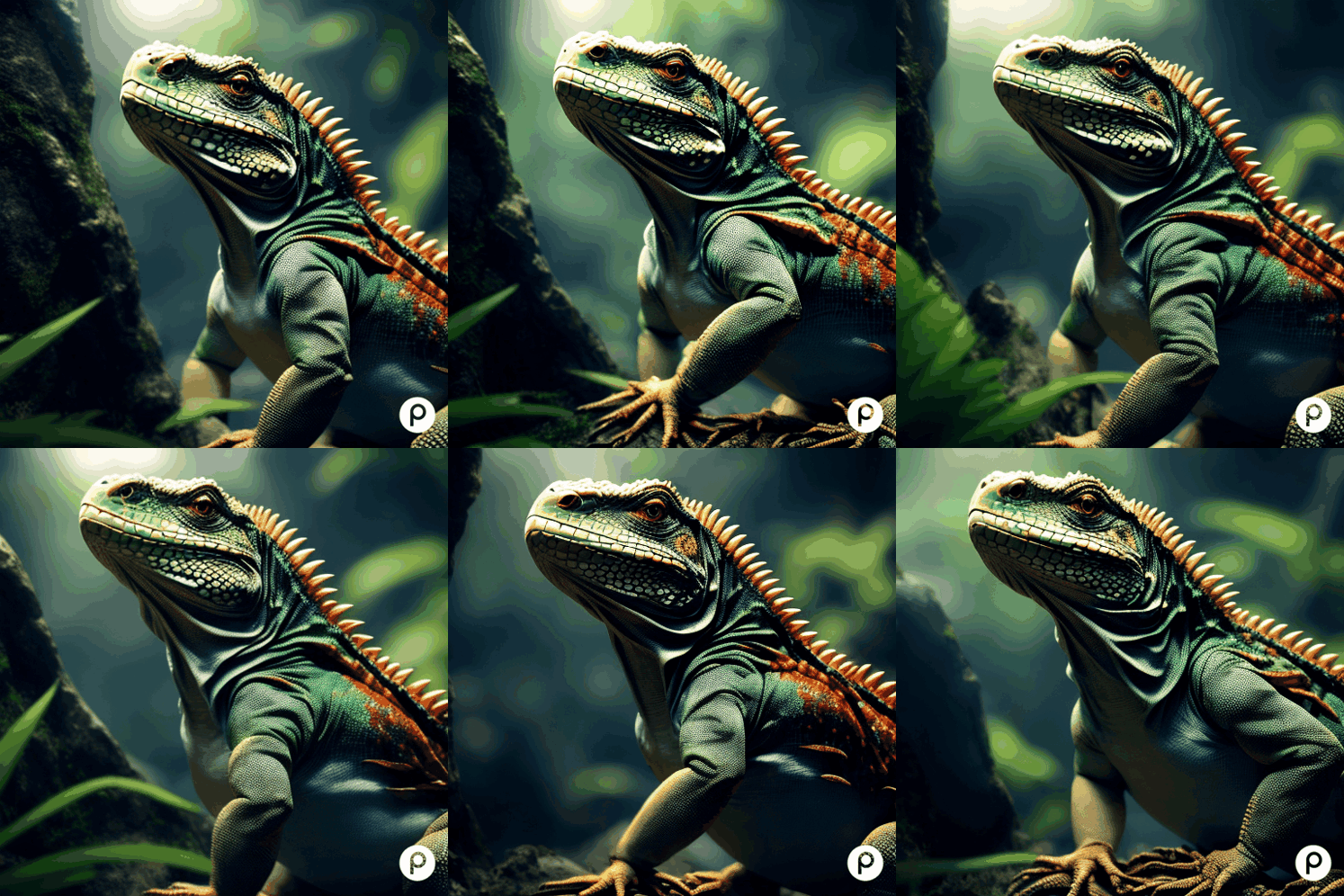
The spiny-tailed iguanas on Mexico’s Clarion Island were long thought to have been introduced by humans. But a study published this October in the journal Ecology and Evolution turns that idea on its head. It suggests the lizards predate humans in the Americas—and that they are an endemic, not invasive, species.
Clarion Island, the oldest on the remote Revillagigedo Archipelago in the Pacific Ocean, was once covered in prickly-pear cactuses that made it almost impenetrable without a machete, per a statement. That all changed in the 1970s, when the Mexican military set up a base on the island and introduced sheep, pigs and rabbits that ate most of the vegetation. Biologists also assumed the iguanas were introduced by military personnel, because previous surveys of the island had not recorded them.
“It was all speculative that they were introduced—no one ever tested it,” Daniel Mulcahy, an evolutionary biologist at the Museum of Natural History in Berlin and the study’s first author, tells the New York Times.
Clarion’s unique wildlife
Iguanas aren’t the only animals endemic to Clarion Island: It’s home to unique birds, snakes and lizards. It also was once the habitat of the Townsend’s shearwater (Puffinus auricularis), a rare seabird that had its nesting sites decimated by the island’s invasive mammals. The bird is now considered “critically endangered” by the International Union for Conservation of Nature, with just 250 to 999 thought to still live in the wild worldwide, according to a 2018 assessment.
Mulcahy tells the outlet that he collected DNA from the iguanas while on a Smithsonian Institution research trip to study snakes more than a decade ago. The DNA materials from the island iguanas didn’t seem to match those of iguanas from the mainland. But he didn’t think to publish those results until a colleague told him the Mexican government planned to exterminate the lizards under the belief that they’re invasive and harming the local ecosystem, he tells the Times.
The result was his new study, which compared the mitochondrial DNA of island and mainland iguanas and found that they are genetically distinct from each other. The researchers’ evolutionary analysis found that the two populations likely diverged some 425,000 years ago. Humans, on the other hand, only crossed the Bering Land Bridge to the Americas roughly 15,000 to 25,000 years ago.
As such, the island’s iguanas “substantially predate not only the establishment of the navy base on Clarion Island but also human colonization of the Americas,” the researchers write in the paper.
This finding, they add, suggests the iguanas dispersed naturally over water—likely on a mat of floating vegetation—to make their way to the island. But that raises another question: How did the Clarion iguanas go unnoticed for so long?
The study authors suggest the reptiles probably remained hidden because of the dense vegetation that once covered the island, allowing the skittish animals to hide. The iguanas tend to run away from humans, hiding in rock crevices or burrows.
“We posit that the iguanas on Clarion Island were historically elusive and that recent alterations to the vegetation have made them more conspicuous,” they write in the study. Though pigs and sheep have now been eradicated from the island, they write, rabbits remain. So does the environmental destruction wrought by the invasive species, which “significantly altered” the island’s native plants.
“This type of work is fundamental to conserving some of the world’s most unique and imperiled diversity,” Rayna Bell, an evolutionary biologist at the California Academy of Sciences who was not involved with the study, tells the New York Times.
The study could have important implications for future conservation plans on the island, now that iguanas can be considered native wildlife. The researchers hope their findings bring an end to Clarion Island’s ongoing iguana eradication efforts.
“This research fundamentally changes how we view Clarion’s ecology,” the team says to Rob Hutchins at Oceanographic magazine. “The spiny-tailed iguana is not an invader—it’s a survivor.”
At Sterling Publishing & Media Service Agency, we prioritise transparency and accountability in all our operations. We wish to clarify that we are not responsible for any external content, hyperlinks, or costs associated with our services. Nevertheless, we remain committed to delivering outstanding services and greatly value your continued support. Thank you for your trust in us.

You must be logged in to post a comment.