



AN EXTRAORDINARY ADVENTURE –
Her name was Annabel and she is the real heroine in this story.
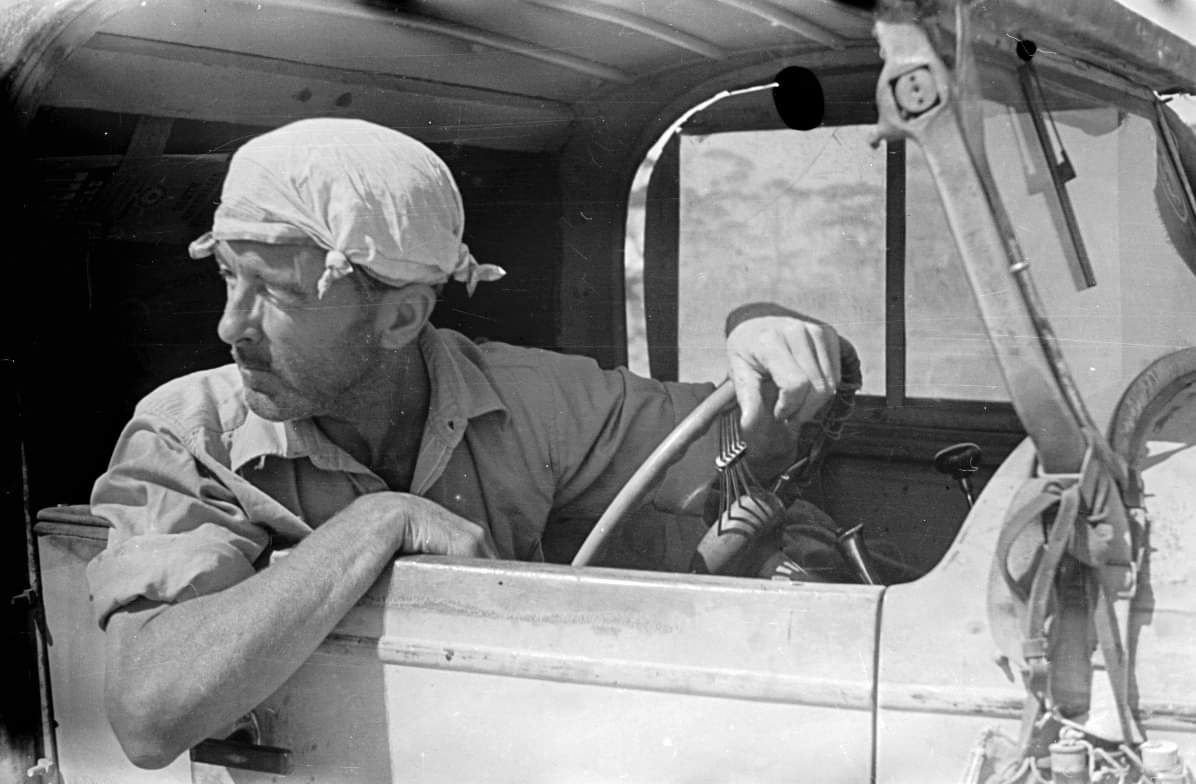
She had been a Queen of the Road – back in 1929 – but her ancient glory had faded when photographer Stuart Gore first saw her in a backyard on the Western Australian goldfields.
“Her tyres were sun-baked, cracked, and useless. Her paintwork blistered. Her headlights smashed and her speedometer showed 100,000 plus on its battered dial.”
But underneath, she was “built like a battleship”.
Stuart bought Annabel for a song. Fitted her with second-hand tyres and a homemade wooden body. Poured petrol in one end and water in the other – and she went!
In 1948 Stuart, his wife Jan, and Annabel set off from Perth to the far north, to show a series of films they had created – ‘See Australia First’.
Their adventure would take them 8,000 miles into the great Australian loneliness. Where high-stepping emus raced at the speed of cruising automobiles, rock pythons sunned their coils on the warm red hills, crocodiles and sawfish infested tidal creeks and rivers, and Aboriginal peoples followed the nomadic life of their ancestors of twenty thousand years gone by.
The first stage of their journey ended in Shark Bay. The town was enveloped in darkness when they pulled in, except for a thin line of disturbed whiteness in the light of Annabel’s head lamps, where the Indian ocean broke fretfully upon the strip of beach parallel to the main street.
“Good evening,” said a friendly voice out of the darkness, “I’m the policeman here. Anything I can do?”
Their providential guide escorted them to the hotel but they’d arrived on the only night of the year when it had guests. So Stuart, Jan, and Annabel took shelter in the old garage out the back. It smelt of fish and was filled with old sails, bits of rope, and tins of tar. The door was held closed only by the bleached half of a whale’s jawbone.
The following day they were given the local hall to give Shark Bay its first taste of the pictures but there was no electricity in the town and they couldn’t get their generator to work.
On to Roebourne and four miles out Annabel’s steering gear became solidly and immovably jammed. But fortunately, it was a straight road all the way into town.
While Annabel lay in the garage stripped down to her steering gear, Stuart and Jan stood on the hill looking down upon the ruins of Roebourne’s past glories. Many buildings were just heaps of masonry, victims of cyclones or “cock-eyed bobs” as they were called at the time.
Stuart arranged to screen ‘See Australia First’ in the Masonic Hall while they waited for a spare part for Annabel. It came by air. There was a special air service three times a week to Roebourne in those days. Even a special plane to carry a dentist, a ladies’ hairdresser, and a photographer from place to place, visiting towns and sheep stations alike.
Annabel was towed from the garage to be stationed outside the hall so her motor could be used to drive the generator. Apart from when Annabel ran out of fuel in the middle of the film plunging the hall into darkness, there were no incidents. The enforced interval was enlivened with considerable local gossip, interspersed with pithy comments around the annual picnic race meeting the following day.
It was a pity that Derby was surrounded by mud flats making camping out of the question. There were two hotels in Derby in 1948. One was full up and the other was the bushman’s pub for men only and everyone slept out on the verandas. The proprietor, however, agreed to try to accommodate the couple and within ten minutes they were presented with a cup of tea and a room. The room had double doors on either end opening up onto verandas lined with iron bedsteads.
“The boys use this room for a shortcut,” the proprietor mentioned casually on his way out, “so if you hear anyone in the night just yell ‘Get the hell out of here!’ and they’ll know it’s occupied. Goodnight.”
However, they were not disturbed and in the morning the occupants of the busman’s pub – cattle drovers, pearling hands, and assorted bushmen – proved to be a most friendly crowd; like everyone else in Derby.
Stuart also had permission from the Health Department to show pictures at the Leprosarium nine miles out of town, Annabel crashing through the low scrub to get there. The picture show was an unqualified success. Roars of delight greeted every fresh image on the screen and caused the cockatoos roosting in the surrounding trees to flee screaming into the bush. Everyone chattered excitedly as they dispersed to their living quarters.
A coastal steamer – the Koolinda – awaited Stuart, Jan, and Annabel back in Derby to take them further North.
“Hold ’er!” yelled a man on the Koolinda’s forecastle, and with a squeal of breaks the rumbling winch stopped, leaving Annabel swaying in mid-air. Anxiously Stuart watched as she was swayed gently down onto the ship’s forward well-deck.
Once on board, Annabel attracted the attention of passengers, some unkind but the consensus of opinion was summed up by one man in three words… “Proper bush buggy”.
The clean sea air was a positive tonic after the sticky heat of the inland and after scratch meals of beef and damper at odd hours, the couple revelled in the well-served meals aboard the ship.
When the Koolinda berthed at Wyndham, the dingy brown heat-haze veiled over the hills and town and dirty muddy water (alive with crocodiles), caused Stuart to liken the scene to “a striking resemblance to a faded sepia photograph”.
Edgar the ship’s purser encouraged Stuart to show the film at the open theatre in the Wyndham Meatworks. “There are the passengers here (ninety of ‘em) and the whole town will come,” he assured Stuart. And it wasn’t long until a “See Australia First” poster was posted on the big old baobab tree in the middle of Wyndham’s main street. Every soul in Wyndham had read it within an hour.
That evening at the Meatworks every deck chair and the wooden seat was occupied. “Townsfolk in all sorts of tropical dress (and undress) from immaculate drill suits to pyjamas, mingled with brightly attired holiday-making girls from the ship. Stockmen in broad-brimmed hats and riding boots, and Aboriginal peoples from outside of town, gave the audience rather a frontier-town look.” And though the full moon washed the film out at times, the audience was not displeased.
Next stop Darwin.
Story courtesy of Stuart Gore, ‘Oerlanding with Annabel’ .-1905-1984.
Below:
Stuart Gore with handkerchief ‘cap’.
Anastasia’s Pool, Broome.
North west bush camp, 1948.
an inside tree hollow, 1948.
North west river crossing, 1948.
North west roads and tracks, 1948.
Bush camp ablutions, 1948 and Annabell, 1948.


You must be logged in to post a comment.