




AceHistoryDesk – see Bit (money).”₿” redirects here. Not to be confused with “฿” for Thai baht.

Ace Press News From Cutting Room Floor: Published: Jan.03: 2024: TELEGRAM Ace Daily News Link https://t.me/+PuI36tlDsM7GpOJe
Bitcoin (abbreviation: BTC[a] or XBT;[b] sign: ₿) is the first decentralizedcryptocurrency. Nodes in the peer-to-peer bitcoin network verify transactions through cryptography and record them in a public distributed ledger, called a blockchain, without central oversight.
Consensus between nodes is achieved using a computationally intensive system based on proof-of-work called mining. Bitcoin mining requires increasing quantities of electricity and was responsible for 0.2% of world greenhouse gas emissions as of 2022.
Based on a free market ideology, bitcoin was invented in 2008 by Satoshi Nakamoto, an unknown person. Use of bitcoin as a currency began in 2009, with the release of its open-source implementation. In 2021, El Salvador adopted it as legal tender. Bitcoin is currently used more as a store of value and less as a medium of exchange or unit of account. It is mostly seen as an investment and has been described by many scholars as an economic bubble. As bitcoin is pseudonymous, its use by criminals has attracted the attention of regulators, leading to its ban by several countries as of 2021.
Background
Before bitcoin, several digital cash technologies were released, starting with David Chaum‘s ecash in the 1980s. The idea that solutions to computational puzzles could have some value was first proposed by cryptographers Cynthia Dwork and Moni Naor in 1992. The concept was independently rediscovered by Adam Back who developed Hashcash, a proof-of-work scheme for spam control in 1997. The first proposals for distributed digital scarcity-based cryptocurrencies came from cypherpunks Wei Dai (b-money) and Nick Szabo (bit gold) in 1998. In 2004, Hal Finney developed the first currency based on reusable proof-of-work. These various attempts were not successful: Chaum’s concept required centralized control and no banks wanted to sign on, Hashcash had no protection against double-spending, while b-money and bit gold were not resistant to Sybil attacks.
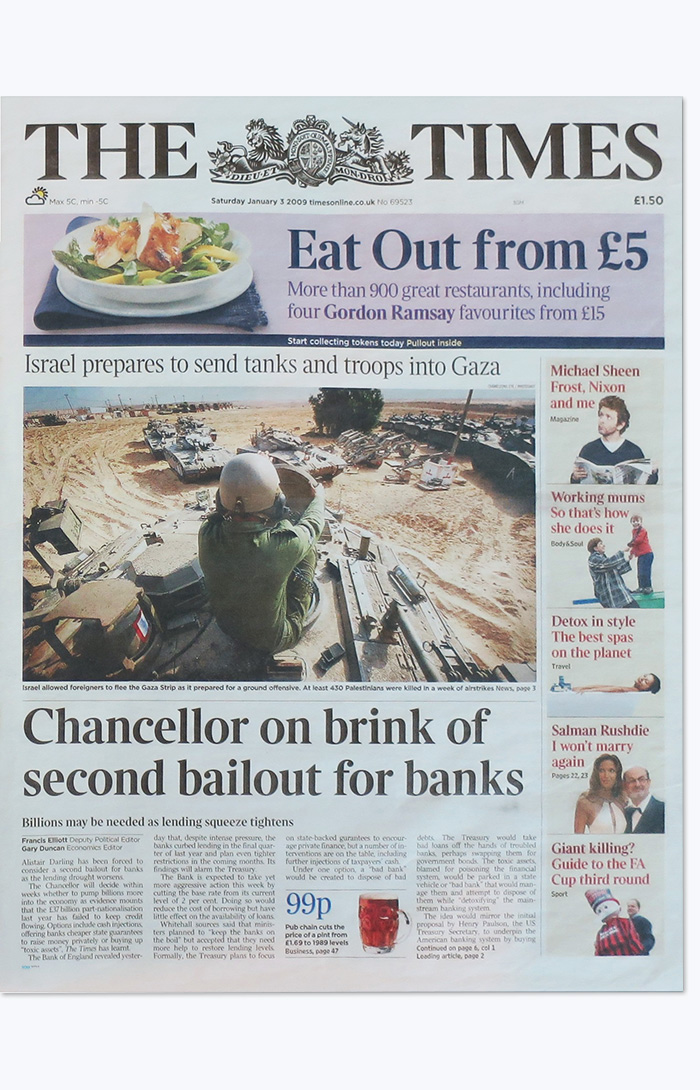
External imageCover page of The Times 3 January 2009 showing the headline used in the genesis block


Bitcoin logos made by Satoshi Nakamoto in 2009 (left) and 2010 (right) depict bitcoins as gold tokens.
The domain name bitcoin.org was registered on 18 August 2008.[15] On 31 October 2008, a link to a white paper authored by Satoshi Nakamototitled Bitcoin: A Peer-to-Peer Electronic Cash System was posted to a cryptography mailing list. Nakamoto implemented the bitcoin software as open-source code and released it in January 2009.[8]Nakamoto’s identity remains unknown. All individual components of bitcoin originated in earlier academic literature. Nakamoto’s innovation was their complex interplay resulting in the first decentralized, Sybil resistant, Byzantine fault tolerant digital cash system, that would eventually be referred to as the first blockchain. Nakamoto’s paper was not peer-reviewed and initially ignored by academics, who argued that it could not work, based on theoretical models, even though it was working in practice.
On 3 January 2009, the bitcoin network was created when Nakamoto mined the starting block of the chain, known as the genesis block.[18]Embedded in this block was the text “The Times 03/Jan/2009 Chancellor on brink of second bailout for banks“, which is the date and headline of an issue of The Times newspaper. Nine days later, Hal Finney received the first bitcoin transaction: ten bitcoins from Nakamoto. Wei Dai and Nick Szabo were also early supporters. In 2010, the first known commercial transaction using bitcoin occurred when programmer Laszlo Hanyecz bought two Papa John’s pizzas for ₿10,000.
2010–2012: Early growth
Blockchain analysts estimate that Nakamoto had mined about one million bitcoins before disappearing in 2010 when he handed the network alert key and control of the code repository over to Gavin Andresen. Andresen later became lead developer at the Bitcoin Foundation, an organization founded in September 2012 to promote bitcoin.
After early “proof-of-concept” transactions, the first major users of bitcoin were black markets, such as the dark web Silk Road. During its 30 months of existence, beginning in February 2011, Silk Road exclusively accepted bitcoins as payment, transacting ₿9.9 million, worth about $214 million.
2013–2014: First regulatory actions
In March 2013, the US Financial Crimes Enforcement Network (FinCEN) established regulatory guidelines for “decentralized virtual currencies” such as bitcoin, classifying American bitcoin miners who sell their generated bitcoins as money services businesses, subject to registration and other legal obligations. In May 2013, US authorities seized the unregistered exchange Mt. Gox. In June 2013, the US Drug Enforcement Administration seized ₿11.02 from a man attempting to use them to buy illegal substances. This marked the first time a government agency had seized bitcoins. The FBI seized about ₿30,000 in October 2013 from Silk Road, following the arrest of its founder Ross Ulbricht.
In December 2013, the People’s Bank of China prohibited Chinese financial institutions from using bitcoin. After the announcement, the value of bitcoin dropped, and Baidu no longer accepted bitcoins for certain services. Buying real-world goods with any virtual currency had been illegal in China since at least 2009.
2015–2019
Research produced by the University of Cambridge estimated that in 2017, there were 2.9 to 5.8 million unique users using a cryptocurrency wallet, most of them using bitcoin. In August 2017, the SegWitsoftware upgrade was activated. Segwit was intended to support the Lightning Network as well as improve scalability. SegWit opponents, who supported larger blocks as a scalability solution, forked to create Bitcoin Cash, one of many forks of bitcoin.
In February 2018, price crashed after China imposed a complete ban on Bitcoin trading. The percentage of bitcoin trading in the Chinese renminbi fell from over 90% in September 2017 to less than 1% in June 2018. During the same year, Bitcoin prices were negatively affected by several hacks or thefts from cryptocurrency exchanges.
2020–present
In 2020, some major companies and institutions started to acquire bitcoin: MicroStrategy invested $250 million in bitcoin as a treasury reserve asset,[40] Square, Inc., $50 million, and MassMutual, $100 million. In November 2020, PayPal added support for bitcoin in the US.
In February 2021, Bitcoin’s market capitalization reached $1 trillion for the first time. In November 2021, the Taproot soft-fork upgrade was activated, adding support for Schnorr signatures, improved functionality of smart contracts and Lightning Network. Before, Bitcoin only used a custom elliptic curve with the ECDSA algorithm to produce signatures. In September 2021, Bitcoin became legal tender in El Salvador, alongside the US dollar.
In May and June 2022, the bitcoin price fell following the collapses of TerraUSD, a stablecoin, and the Celsius Network, a decentralized finance loan company.
In 2023, ordinals, non-fungible tokens (NFTs) on Bitcoin, went live.
Design: Bitcoin protocol
Units and divisibility
The unit of account of the bitcoin system is the bitcoin. It is represented with the currency codes BTC[a] and XBT[b] as well as the symbol ₿. No uniform capitalization convention exists; some sources use Bitcoin, capitalized, to refer to the technology and network, and bitcoin, lowercase, for the unit of account. The Oxford English Dictionaryadvocates the use of lowercase bitcoin in all cases.
One bitcoin is divisible to eight decimal places. ch. 5 Units for smaller amounts of bitcoin are the millibitcoin (mBTC), equal to 1⁄1000 bitcoin, and the satoshi[c] (sat), representing 1⁄100000000 (one hundred millionth) bitcoin, the smallest amount possible. 100,000 satoshis are one mBTC.
Blockchain § Structure and design
As a decentralized system, bitcoin operates without a central authority or single administrator, so that anyone can create a new bitcoin address and transact without needing any approval. ch. 1 This is accomplished through a specialized distributed ledger called a blockchain that records bitcoin transactions.
The blockchain is implemented as an ordered list of blocks. Each block contains a SHA-256 hash of the previous block, “chaining” them in chronological order. ch. The blockchain is maintained by a peer-to-peer network. Individual blocks, public addresses, and transactions within blocks are public information, and can be examined using a blockchain explorer.
Nodes validate and broadcast transactions, each maintaining a copy of the blockchain for ownership verification. A new block is created every 10 minutes on average, updating the blockchain across all nodes without central oversight. This process tracks bitcoin spending, ensuring each bitcoin is spent only once. Unlike a traditional ledger that tracks physical currency, bitcoins exist digitally as unspent outputs of transactions.
Addresses and transactions
In the blockchain, bitcoins are linked to specific addresses that are hashes of a public key. Creating an address involves generating a random private key and then computing the corresponding address. This process is almost instant, but the reverse (finding the private key for a given address) is nearly impossible. Publishing a bitcoin address does not risk its private key, and it is extremely unlikely to accidentally generate a used key with funds. To use bitcoins, owners need their private key to digitally sign transactions, which are verified by the network using the public key, keeping the private key secret. ch. 5
Bitcoin transactions use a Forth-like scripting language, involving one or more inputs and outputs. When sending bitcoins, a user specifies the recipients’ addresses and the amount for each output. This allows sending bitcoins to several recipients in a single transaction. To prevent double-spending, each input must refer to a previous unspent output in the blockchain. Using multiple inputs is similar to using multiple coins in a cash transaction. As in a cash transaction, the sum of inputs can exceed the intended sum of payments. In such a case, an additional output can return the change back to the payer. Unallocated input satoshis in the transaction become the transaction fee.
Losing a private key means losing access to the bitcoins, with no other proof of ownership accepted by the protocol. For instance, in 2013, a user lost ₿7,500, valued at US$7.5 million, by accidentally discarding a hard drive with the private key. It is estimated that around 20% of all bitcoins are lost. The private key must also be kept secret as its exposure, such as through a data breach, can lead to theft of the associated bitcoins. As of December 2017[update], approximately ₿980,000 had been stolen from cryptocurrency exchanges.
Bitcoin protocol § Mining
The mining process in Bitcoin involves maintaining the blockchain through computer processing power. Miners group and broadcast new transactions into blocks, which are then verified by the network. Each block must contain a proof-of-work (PoW) to be accepted involving finding a nonce number that, combined with the block content, produces a hash numerically smaller than the network’s difficulty target. The PoW is simple to verify but hard to generate, requiring many attempts. PoW forms the basis of Bitcoin’s consensus mechanism.
The difficulty of generating a block is deterministically adjusted based on the mining power on the network by changing the difficulty target, which is recalibrated every 2,016 blocks (approximately two weeks) to maintain an average time of ten minutes between new blocks. The process requires significant computational power and specialized hardware.
Miners who successfully find a new block can collect transaction fees from the included transactions and a set reward in bitcoins. To claim this reward, a special transaction called a coinbase is included in the block, with the miner as the payee. All bitcoins in existence have been created through this type of transaction. This reward is halved every 210,000 blocks until ₿21 million, with new bitcoin issuance slated to end around 2140. Afterward, miners will only earn from transaction fees. These fees are determined by the transaction’s size and the amount of data stored, measured in satoshis per byte.
The proof-of-work system and the chaining of blocks make blockchain modifications very difficult, as altering one block requires changing all subsequent blocks. As more blocks are added, modifying older blocks becomes increasingly challenging. In case of disagreement, nodes trust the longest chain, which required the greatest amount of effort to produce. To tamper or censor the ledger, one needs to control the majority of the global hashrate. The high cost required to reach this level of computational power guarantees the security of the bitcoin blockchain.
Bitcoin mining’s environmental impact is significant and has attracted the attention of regulators, leading to restrictions or bans in various jurisdictions. As of 2022[update], bitcoin mining is estimated to represent 0.4% of global electricity consumption and to be responsible for 0.2% of world greenhouse gas emissions, as about half of the electricity used is generated through fossil fuels.Moreover, mining hardware’s short lifespan results in electronic waste. The amount of electrical energy and e-waste generated by bitcoin mining is often compared with countries like Greece or the Netherlands.
Privacy and fungibility
Bitcoin is pseudonymous, with funds linked to addresses, not real-world identities. While the owners of these addresses are not directly identified, all transactions are public on the blockchain. Patterns of use, like spending coins from multiple inputs, can hint at a common owner. Public data can sometimes be matched with known address owners. Bitcoin exchanges might also need to collect personal data as per legal requirements. For enhanced privacy, users can generate a new address for each transaction.
In the Bitcoin network, each bitcoin is treated equally, ensuring basic fungibility. However, users and applications can choose to differentiate between bitcoins. While wallets and software treat all bitcoins the same, each bitcoin’s transaction history is recorded on the blockchain. This public record allows for chain analysis, where users can identify and potentially reject bitcoins from controversial sources. For example, in 2012, Mt. Gox froze accounts containing bitcoins identified as stolen.
Notes
- ^ a b c BTC is a commonly used code, but it does not conform to ISO 4217 as BT is the country code of Bhutan, and ISO 4217 requires the first letter used in global commodities to be ‘X’.
- ^ a b c XBT, a code that conforms to ISO 4217 though is not officially part of it, is used by Bloomberg L.P.,[51] CNNMoney,[52] and xe.com.[53]
- ^ a b Named after Satoshi Nakamoto.
- ^ a b The exact number is ₿20,999,999.9769.[9]: ch. 8
References
- ^ a b “Unicode 10.0.0”. Unicode Consortium. 20 June 2017. Archivedfrom the original on 20 June 2017. Retrieved 20 June 2017.none
- ^ a b Bradbury, Danny (November 2013). “The problem with Bitcoin”. Computer Fraud & Security. 2013 (11): 5–8. doi:10.1016/S1361-3723(13)70101-5.none
- “Bitcoin Core Releases”. Retrieved 24 October 2023 – via GitHub.none
- ^ a b c d e f “El Salvador’s dangerous gamble on bitcoin”. The editorial board. Financial Times. 7 September 2021. Retrieved 7 September2021.none
- Huang, Jon; O’Neill, Claire; Tabuchi, Hiroko (3 September 2021). “Bitcoin Uses More Electricity Than Many Countries. How Is That Possible?”. The New York Times. ISSN 0362-4331. Retrieved 26 October 2022.none
- de Vries, Alex; Gallersdörfer, Ulrich; Klaaßen, Lena; Stoll, Christian (16 March 2022). “Revisiting Bitcoin’s carbon footprint”. Joule. 6(3): 498–502. doi:10.1016/j.joule.2022.02.005. ISSN 2542-4351. S2CID 247143939.none
- ^ a b S., L. (2 November 2015). “Who is Satoshi Nakamoto?”. The Economist.none
- ^ a b c d Davis, Joshua (10 October 2011). “The Crypto-Currency: Bitcoin and its mysterious inventor”. The New Yorker. Archived from the original on 1 November 2014. Retrieved 31 October 2014.none
- ^ a b c d e f g h i j k l m n o p q r s Antonopoulos, Andreas M. (2014). Mastering Bitcoin: Unlocking Digital Crypto-Currencies. O’Reilly Media. ISBN 978-1-4493-7404-4.none
- ^ a b Wolff-Mann, Ethan (27 April 2018). “‘Only good for drug dealers’: More Nobel prize winners snub bitcoin”. Yahoo Finance. Archived from the original on 12 June 2018. Retrieved 7 June2018.none
- ^ a b Sun Yin, Hao Hua; Langenheldt, Klaus; Harlev, Mikkel; Mukkamala, Raghava Rao; Vatrapu, Ravi (2 January 2019). “Regulating Cryptocurrencies: A Supervised Machine Learning Approach to De-Anonymizing the Bitcoin Blockchain”. Journal of Management Information Systems. 36 (1): 65. doi:10.1080/07421222.2018.1550550. ISSN 0742-1222. S2CID 132398387.none
- ^ a b c d e f g h Narayanan, Arvind; Clark, Jeremy (27 November 2017). “Bitcoin’s academic pedigree”. Communications of the ACM. 60(12): 36–45. doi:10.1145/3132259. ISSN 0001-0782. S2CID 6425116.none
- Tschorsch, Florian; Scheuermann, Bjorn (2 March 2016). “Bitcoin and Beyond: A Technical Survey on Decentralized Digital Currencies”. IEEE Communications Surveys & Tutorials. 18 (3): 2084–2123. doi:10.1109/COMST.2016.2535718. ISSN 1553-877X. S2CID 5115101.none
- Judmayer, Aljosha; Stifter, Nicholas; Krombholz, Katharina; Weippl, Edgar (2017). “History of Cryptographic Currencies”. Blocks and Chains. Synthesis Lectures on Information Security, Privacy, and Trust. Springer. pp. 15–18. doi:10.1007/978-3-031-02352-1_3. ISBN 978-3-031-01224-2.none
- Bernard, Zoë (2 December 2017). “Everything you need to know about Bitcoin, its mysterious origins, and the many alleged identities of its creator”. Business Insider. Archived from the original on 15 June 2018. Retrieved 15 June 2018.none
- Finley, Klint (31 October 2018). “After 10 Years, Bitcoin Has Changed Everything—And Nothing”. Wired. Archived from the original on 5 November 2018. Retrieved 9 November 2018.none
- Economist Staff (31 October 2015). “Blockchains: The great chain of being sure about things”. The Economist. Archived from the original on 3 July 2016. Retrieved 18 June 2016.none
- ^ a b Wallace, Benjamin (23 November 2011). “The Rise and Fall of Bitcoin”. Wired. Archived from the original on 31 October 2013. Retrieved 13 October 2012.none
- Popper, Nathaniel (30 August 2014). “Hal Finney, Cryptographer and Bitcoin Pioneer, Dies at 58”. The New York Times. Archived from the original on 3 September 2014. Retrieved 2 September 2014.none
- Cooper, Anderson (16 May 2019). “Meet the man who spent millions worth of bitcoin on pizza”. CBS News.none
- McMillan, Robert. “Who Owns the World’s Biggest Bitcoin Wallet? The FBI”. Wired. Archived from the original on 21 October 2016. Retrieved 7 October 2016.none
- Simonite, Tom (15 August 2014). “Meet Gavin Andresen, the most powerful person in the world of Bitcoin”. MIT Technology Review.none
- Odell, Matt (21 September 2015). “A Solution To Bitcoin’s Governance Problem”. TechCrunch. Archived from the original on 26 January 2016. Retrieved 24 January 2016.none
- Bustillos, Maria (1 April 2013). “The Bitcoin Boom”. The New Yorker. Archived from the original on 2 July 2018. Retrieved 30 July2018.none
- ^ a b c d e f g Rainer Böhme; Nicolas Christin; Benjamin Edelman; Tyler Moore (2015). “Bitcoin: Economics, Technology, and Governance”. Journal of Economic Perspectives. 29 (2): 213–238. doi:10.1257/jep.29.2.213.none
- Lee, Timothy B. (19 March 2013). “US regulator Bitcoin Exchanges Must Comply With Money Laundering Laws”. Ars Technica. Archivedfrom the original on 21 October 2013. Retrieved 28 July 2017.none
- Dillet, Romain. “Feds Seize Assets From Mt. Gox’s Dwolla Account, Accuse It Of Violating Money Transfer Regulations”. TechCrunch. Archived from the original on 9 October 2013. Retrieved 15 May2013.none
- Sampson, Tim (2013). “U.S. government makes its first-ever Bitcoin seizure”. The Daily Dot. Archived from the original on 12 July 2013. Retrieved 15 October 2013.none
- Hill, Kashmir. “The FBI’s Plan For The Millions Worth Of Bitcoins Seized From Silk Road”. Forbes. Archived from the original on 2 May 2014.none
- Kelion, Leo (18 December 2013). “Bitcoin sinks after China restricts yuan exchanges”. BBC News. Archived from the original on 19 December 2013. Retrieved 20 December 2013.none
- “China bans banks from bitcoin transactions”. The Sydney Morning Herald. Reuters. 6 December 2013. Archived from the original on 23 March 2014. Retrieved 31 October 2014.none
- “Baidu Stops Accepting Bitcoins After China Ban”. Bloomberg. New York. 7 December 2013. Archived from the original on 10 December 2013. Retrieved 11 December 2013.none
- “China bars use of virtual money for trading in real goods”. English.mofcom.gov.cn. 29 June 2009. Archived from the original on 29 November 2013. Retrieved 10 January 2014.none
- Hileman, Garrick; Rauchs, Michel. “Global Cryptocurrency Benchmarking Study” (PDF). Cambridge University. Archived (PDF)from the original on 10 April 2017. Retrieved 14 April 2017.none
- Vigna, Paul (21 July 2017). “Bitcoin Rallies Sharply After Vote Resolves Bitter Scaling Debate”. The Wall Street Journal.none
- Selena Larson (1 August 2017). “Bitcoin split in two, here’s what that means”. CNN Tech. Cable News Network. Archived from the original on 27 February 2018. Retrieved 2 April 2018.none
- French, Sally (9 February 2017). “Here’s proof that this bitcoin crash is far from the worst the cryptocurrency has seen”. Market Watch. Archived from the original on 3 July 2018. Retrieved 3 July2018.none
- “RMB Bitcoin trading falls below 1 pct of world total”. Xinhuanet. Xinhua. 7 July 2018. Archived from the original on 10 July 2018. Retrieved 10 July 2018.none
- Chavez-Dreyfuss, Gertrude (3 July 2018). “Cryptocurrency exchange theft surges in first half of 2018: report”. Reuters. Archived from the original on 4 July 2018. Retrieved 10 July2018.none
- Cuthbertson, Anthony (13 September 2021). “MicroStrategy buys another $250m worth of bitcoin in hope of 100X price growth”. The Independent. Retrieved 22 November 2023.none
- Oliver Effron. “Square just bought $50 million in bitcoin”. CNN. Retrieved 22 October 2020.none
- Olga Kharif (11 December 2020). “169-Year-Old MassMutual Invests $100 Million in Bitcoin”. Bloomberg. Retrieved 26 December2020.none
- “PayPal says all users in US can now buy, hold and sell cryptocurrencies”. Techcrunch. 13 November 2020. Retrieved 26 November 2020.none
- Chavez-Dreyfuss, Gertrude; Wilson, Tom (19 February 2021). “Bitcoin hits $1 trillion market cap, surges to fresh all-time peak”. Reuters. Retrieved 24 November 2023.none
- Sigalos, MacKenzie (14 November 2021). “Bitcoin’s biggest upgrade in four years just happened – here’s what changes”. CNBC. Retrieved 15 November 2021.none
- Van Hijfte, Stijn (2020). Blockchain Platforms: A Look at the Underbelly of Distributed Platforms. Morgan & Claypool Publishers. ISBN 978-1681738925.none
- Browne, Ryan (10 May 2022). “Bitcoin investors are panicking as a controversial crypto experiment unravels”. CNBC.none
- Milmo, Dan (18 June 2022). “Bitcoin value slumps below $20,000 in cryptocurrencies turmoil”. The Guardian. Retrieved 19 June2022.none
- Yaffe-Bellany, David (13 June 2022). “Celsius Network Leads Crypto Markets Into Another Free Fall”. The New York Times.none
- Behrendt, Philipp (2023). “Taxation of the New Age: New Guidance for the World of Digital Assets”. Journal of Tax Practice & Procedure. 25: 47.none
- Romain Dillet (9 August 2013). “Bitcoin Ticker Available On Bloomberg Terminal For Employees”. TechCrunch. Archived from the original on 1 November 2014. Retrieved 2 November 2014.none
- “Bitcoin Composite Quote (XBT)”. CNN Money. Archived from the original on 27 October 2014. Retrieved 2 November 2014.none
- “XBT – Bitcoin”. xe.com. Archived from the original on 2 November 2014. Retrieved 2 November 2014.none
- Bustillos, Maria (2 April 2013). “The Bitcoin Boom”. The New Yorker. Archived from the original on 27 July 2014. Retrieved 22 December2013.none
- “bitcoin”. OxfordDictionaries.com. Archived from the original on 2 January 2015. Retrieved 28 December 2014.none
- Katie Pisa; Natasha Maguder (9 July 2014). “Bitcoin your way to a double espresso”. CNN. Archived from the original on 18 June 2015. Retrieved 23 April 2015.none
- ^ a b c Gervais, Arthur; Karame, Ghassan O.; Capkun, Vedran; Capkun, Srdjan (May 2014). “Is Bitcoin a Decentralized Currency?”. IEEE Security & Privacy. 12 (3): 54–60. doi:10.1109/MSP.2014.49. ISSN 1540-7993. S2CID 13948781.none
- ^ a b c d e f “The great chain of being sure about things”. The Economist. 31 October 2015.none
- “Blockchain Networks: Token Design and Management Overview”(PDF). National Institute of Standards Technology (NIST). p. 32. Retrieved 29 December 2022.none
- Sparkes, Matthew (9 June 2014). “The coming digital anarchy”. The Daily Telegraph. Archived from the original on 23 January 2015. Retrieved 7 January 2015.none
- ^ a b c d e Kroll, Joshua A.; Davey, Ian C.; Felten, E. (11–12 June 2013). The Economics of Bitcoin Mining, or Bitcoin in the Presence of Adversaries. The Twelfth Workshop on the Economics of Information Security (WEIS 2013). Washington, DC. S2CID 2794725.none
- “Man Throws Away 7,500 Bitcoins, Now Worth $7.5 Million”. CBS DC. 29 November 2013. Archived from the original on 15 January 2014. Retrieved 23 January 2014.none
- Krause, Elliott (5 July 2018). “A Fifth of All Bitcoin Is Missing. These Crypto Hunters Can Help”. The Wall Street Journal. Archived from the original on 9 July 2018. Retrieved 8 July 2018.none
- Jeffries, Adrianne (19 December 2013). “How to steal Bitcoin in three easy steps”. The Verge. Archived from the original on 27 July 2019. Retrieved 17 January 2014.none
- Harney, Alexandra; Stecklow, Steve (16 November 2017). “Twice burned – How Mt. Gox’s bitcoin customers could lose again”. Reuters. Archived from the original on 29 August 2019. Retrieved 6 September 2018.none
- ^ a b c d Mingxiao, Du; Xiaofeng, Ma; Zhe, Zhang; Xiangwei, Wang; Qijun, Chen (5–8 October 2017). A review on consensus algorithm of blockchain. 2017 IEEE International Conference on Systems, Man, and Cybernetics (SMC). Banff, AB, Canada: IEEE. pp. 2567–2572. doi:10.1109/SMC.2017.8123011. ISBN 978-1-5386-1645-1.none
- “Bitcoin boom benefiting TSMC: report”. Taipei Times. 4 January 2014.none
- Ashlee, Vance (14 November 2013). “2014 Outlook: Bitcoin Mining Chips, a High-Tech Arms Race”. BusinessWeek. Archived from the original on 21 November 2013. Retrieved 24 November 2013.none
- King, Ritchie S.; Williams, Sam; Yanofsky, David (17 December 2013). “By reading this article, you’re mining bitcoins”. Quartz.none
- Hampton, Nikolai (5 September 2016). “Understanding the blockchain hype: Why much of it is nothing more than snake oil and spin”. Computerworld. Archived from the original on 6 September 2016. Retrieved 5 September 2016.none
- Stoll, Christian; Klaaßen, Lena; Gallersdörfer, Ulrich; Neumüller, Alexander (June 2023). Climate Impacts of Bitcoin Mining in the U.S.(Report). Working Paper Series. MIT Center for Energy and Environmental Policy Research.none
- Messina, Irene (31 August 2023). “Bitcoin electricity consumption: an improved assessment”. Cambridge Judge Business School. Retrieved 7 September 2023.none
- ^ a b de Vries, Alex; Gallersdörfer, Ulrich; Klaaßen, Lena; Stoll, Christian (16 March 2022). “Revisiting Bitcoin’s carbon footprint”. Joule. 6 (3): 499. doi:10.1016/j.joule.2022.02.005. ISSN 2542-4351. S2CID 247143939.none
- Huang, Jon; O’Neill, Claire; Tabuchi, Hiroko (3 September 2021). “Bitcoin Uses More Electricity Than Many Countries. How Is That Possible?”. The New York Times. ISSN 0362-4331.none
- ^ a b de Vries, Alex; Stoll, Christian (December 2021). “Bitcoin’s growing e-waste problem”. Resources, Conservation and Recycling. 175: 105901. doi:10.1016/j.resconrec.2021.105901. ISSN 0921-3449. S2CID 240585651.none
- Simonite, Tom (5 September 2013). “Mapping the Bitcoin Economy Could Reveal Users’ Identities”. MIT Technology Review. Retrieved 2 April 2014.none
- Lee, Timothy (21 August 2013). “Five surprising facts about Bitcoin”. The Washington Post.none
- McMillan, Robert (6 June 2013). “How Bitcoin lets you spy on careless companies”. Wired UK. Archived from the original on 9 February 2014. Retrieved 3 April 2020.none
- Anderson, Ross; Shumailov, Ilia; Ahmed, Mansoor (24 November 2018). “Making Bitcoin Legal”. In Matyáš, Vashek; Švenda, Petr; Stajano, Frank; Christianson, Bruce (eds.). Security Protocols XXVI. Lecture Notes in Computer Science. Vol. 11286. Springer. pp. 243–253. doi:10.1007/978-3-030-03251-7_29. ISBN 978-3-030-03250-0.none
- Möser, Malte; Böhme, Rainer; Breuker, Dominic (2013). An Inquiry into Money Laundering Tools in the Bitcoin Ecosystem (PDF). 2013 APWG eCrime Researchers Summit. IEEE. ISBN 978-1-4799-1158-5. Archived (PDF) from the original on 26 June 2018. Retrieved 19 June 2019.none
- Serwer, Adam; Liebelson, Dana (10 April 2013). “Bitcoin, Explained”. Mother Jones. Archived from the original on 27 April 2014. Retrieved 26 April 2014.none
- Vigna, Paul (17 January 2016). “Is Bitcoin Breaking Up?”. The Wall Street Journal. Archived from the original on 20 August 2016. Retrieved 8 November 2016.none
- Gervais, Arthur; Capkun, Srdjan; Karame, Ghassan O.; Gruber, Damian (8 December 2014). “On the privacy provisions of Bloom filters in lightweight bitcoin clients”. Proceedings of the 30th Annual Computer Security Applications Conference. ACSAC ’14. New York, NY, USA: Association for Computing Machinery. pp. 326–335. doi:10.1145/2664243.2664267. ISBN 978-1-4503-3005-3. S2CID 9161497.none
- Barhydt, Bill (4 June 2014). “3 reasons Wall Street can’t stay away from bitcoin”. CNBC.none
- Roberts, Daniel (15 December 2017). “How to send bitcoin to a hardware wallet”. Yahoo Finance. Archived from the original on 17 February 2018. Retrieved 17 February 2018.none
- Mike Orcutt (19 May 2015). “Leaderless Bitcoin Struggles to Make Its Most Crucial Decision”. MIT Technology Review. Retrieved 15 November 2016.none
- Orcutt, Mike (19 May 2015). “Leaderless Bitcoin Struggles to Make Its Most Crucial Decision”. MIT Technology Review. Archived from the original on 18 October 2017. Retrieved 22 June 2017.none
- Tschorsch, Florian; Scheuermann, Björn (2016). “Bitcoin and Beyond: A Technical Survey on Decentralized Digital Currencies”. IEEE Communications Surveys and Tutorials. 18 (3): 2084–2123. doi:10.1109/comst.2016.2535718. S2CID 5115101.none
- Wilhelm, Alex. “Popular Bitcoin Mining Pool Promises To Restrict Its Compute Power To Prevent Feared ‘51%’ Fiasco”. TechCrunch. Archived from the original on 5 December 2017. Retrieved 25 January 2018.none
- European Central Bank (2012). Virtual Currency Schemes (PDF). European Central Bank. doi:10.2866/47380. ISBN 978-92-899-0862-7. OCLC 1044382974. Archived (PDF) from the original on 6 November 2012.none
- Dodd, Nigel (May 2018). “The Social Life of Bitcoin” (PDF). Theory, Culture & Society. 35 (3): 35–56. doi:10.1177/0263276417746464. ISSN 0263-2764. S2CID 51914607.none
- ^ a b “Bitcoin and other cryptocurrencies are useless”. The Economist. 30 August 2018. Archived from the original on 4 September 2018. Retrieved 4 September 2018.none
- Feuer, Alan (14 December 2013). “The Bitcoin Ideology”. The New York Times. Archived from the original on 1 July 2018. Retrieved 1 July 2018.none
- ^ a b Mohamed, Theron (30 May 2023). “Nobel economist Paul Krugman slams crypto as mostly useless, after saying it’s hugely overpriced and helps criminals”. Business Insider.none
- ^ a b “Free Exchange. Money from nothing. Chronic deflation may keep Bitcoin from displacing its rivals”. The Economist. 15 March 2014. Archived from the original on 25 March 2014. Retrieved 25 March 2014.none
- “The magic of mining”. The Economist. 13 January 2015. Archivedfrom the original on 12 January 2015. Retrieved 13 January2015.none
- Shiller, Robert (1 March 2014). “In Search of a Stable Electronic Currency”. The New York Times. Archived from the original on 24 October 2014.none
- Velde, François (December 2013). “Bitcoin: A primer” (PDF). Chicago Fed letter. Federal Reserve Bank of Chicago. p. 4. Archived(PDF) from the original on 26 October 2014. Retrieved 3 September2016.none
- Wile, Rob (6 April 2014). “St. Louis Fed Economist: Bitcoin Could Be A Good Threat To Central Banks”. Business Insider. Archived from the original on 24 September 2015. Retrieved 16 April 2014.none
- Weindling, Jacob (18 September 2017). “China May Be Gearing Up to Ban Bitcoin”. Paste.none
- Lavin, Tim (8 August 2013). “The SEC Shows Why Bitcoin Is Doomed”. Bloomberg News. Archived from the original on 25 March 2014. Retrieved 20 October 2013.none
- Montag, Ali (9 July 2018). “Nobel-winning economist: Authorities will bring down ‘hammer’ on bitcoin”. CNBC. Archived from the original on 11 July 2018. Retrieved 11 July 2018.none
- “Regulation of Cryptocurrency Around the World: November 2021 Update” (PDF). United States Library of Congress.none
- ^ a b c Murphy, Hannah (8 June 2018). “Who really owns bitcoin now?”. Financial Times. Archived from the original on 10 June 2018. Retrieved 10 June 2018.none
- “Monetarists Anonymous”. The Economist. 29 September 2012. ISSN 0013-0613. Retrieved 22 November 2023.none
- Ball, James (22 March 2013). “Silk Road: the online drug marketplace that officials seem powerless to stop”. The Guardian. ISSN 0261-3077. Retrieved 22 November 2023.none
- Katz, Lily (12 July 2017). “Bitcoin Acceptance Among Retailers Is Low and Getting Lower”. Bloomberg News. Archived from the original on 25 January 2018. Retrieved 25 January 2018.none
- Kharif, Olga (1 August 2018). “Bitcoin’s Use in Commerce Keeps Falling Even as Volatility Eases”. Bloomberg News. Archived from the original on 2 August 2018. Retrieved 2 August 2018.none
- Chan, Bernice (16 January 2015). “Bitcoin transactions cut the cost of international money transfers”. South China Morning Post. Archived from the original on 31 May 2019. Retrieved 31 May2019.none
- “Majority of Salvadorans do not want bitcoin, poll shows”. Reuters. 2 September 2021. Retrieved 30 November 2021.none
- “IMF urges El Salvador to remove Bitcoin as legal tender”. BBC News. 26 January 2022.none
- Alvarez, Fernando; Argente, David; Van Patten, Diana (2022). Are Cryptocurrencies Currencies? Bitcoin as Legal Tender in El Salvador (Report). Cambridge, MA: National Bureau of Economic Research. doi:10.3386/w29968.none
- “Bitcoin Declared Legal Currency in Central African Republic”. Bloomberg. 28 April 2022. Retrieved 28 April 2022.none
- “Frequently Asked Questions on Central African Republic”. International Monetary Fund. Retrieved 11 August 2023.none
- Rasool, Mohammed (3 November 2020). “Iran Is Pivoting to Bitcoin”. Vice.none
- “Iran: New Crypto Law Requires Selling Bitcoin Directly to Central Bank to Fund Imports”. Asharq Al-Awsat. 31 October 2020.none
- Kohler, Judith (21 September 2022). “Colorado accepts cryptocurrency to pay taxes, moving the state “tech forward””. The Denver Post.none
- “‘Crypto Valley’ canton to accept Bitcoin for tax payments”. SWI swissinfo. 3 September 2020.none
- “Jersey approve Bitcoin fund launch on island”. BBC News. 10 July 2014. Archived from the original on 10 July 2014. Retrieved 10 July2014.none
- “Chicago Mercantile Exchange jumps into bitcoin futures”. CBS News. 18 December 2017. Archived from the original on 31 May 2019. Retrieved 31 May 2019.none
- Lee, Timothy B. “The $11 million in bitcoins the Winklevoss brothers bought is now worth $32 million”. The Washington Post. Archivedfrom the original on 6 July 2017. Retrieved 11 August 2017.none
- Maidenberg, Micah; Driebusch, Corrie; Jin, Berber (17 August 2023). “A Rare Look Into the Finances of Elon Musk’s Secretive SpaceX”. The Wall Street Journal. Retrieved 19 November2023.none
- Ostroff, Caitlin; Elliott, Rebecca (8 February 2021). “Tesla Buys $1.5 Billion in Bitcoin”. The Wall Street Journal. ISSN 0099-9660. Retrieved 22 November 2023.none
- Vigna, Paul (20 December 2021). “Bitcoin’s ‘One Percent’ Controls Lion’s Share of the Cryptocurrency’s Wealth”. Wall Street Journal. ISSN 0099-9660.none
- Cota, Isabella (2 September 2023). “Two years of bitcoin in Bukele’s El Salvador: An opaque experiment with a little-used currency”. El País.none
- Gandal, Neil; Hamrick, J.T.; Moore, Tyler; Oberman, Tali (May 2018). “Price manipulation in the Bitcoin ecosystem”. Journal of Monetary Economics. 95: 86–96. doi:10.1016/j.jmoneco.2017.12.004. S2CID 26358036.none
- Griffin, John M.; Shams, Amin (August 2020). “Is Bitcoin Really Untethered?”. The Journal of Finance. 75 (4): 1913–1964. doi:10.1111/jofi.12903. ISSN 0022-1082. S2CID 229576274.none
- Popper, Nathaniel (13 June 2018). “Bitcoin’s Price Was Artificially Inflated Last Year, Researchers Say”. The New York Times. Archivedfrom the original on 13 June 2018. Retrieved 13 June 2018.none
- Costelloe, Kevin (29 November 2017). “Bitcoin ‘Ought to Be Outlawed,’ Nobel Prize Winner Stiglitz Says”. Bloomberg News. Archived from the original on 12 June 2018. Retrieved 5 June 2018.
It doesn’t serve any socially useful function.
none - Authers, John (9 June 2021). “Don’t Call Bitcoin a Bubble. It’s an Epidemic”. Bloomberg.com. Archived from the original on 10 June 2021.none
- Klein, Tony; Pham Thu, Hien; Walther, Thomas (October 2018). “Bitcoin is not the New Gold – A comparison of volatility, correlation, and portfolio performance” (PDF). International Review of Financial Analysis. 59: 105–116. doi:10.1016/j.irfa.2018.07.010. S2CID 158400153.none
- Mazur, Mieszko (31 March 2022). “Misperceptions of Bitcoin Volatility”. The Journal of Alternative Investments. 24 (4): 33–44. doi:10.3905/jai.2022.1.153. ISSN 1520-3255. S2CID 247843794.none
- Montag, Ali (26 August 2018). “‘HODL,’ ‘whale’ and 5 other cryptocurrency slang terms explained”. CNBC.none
- Hajric, Vildana (19 November 2020). “All the Bitcoin Lingo You Need to Know as Crypto Heats Up”. Bloomberg. Retrieved 1 December2020.none
- Clinch, Matt (10 March 2014). “Roubini launches stinging attack on bitcoin”. CNBC.none
- “This Billionaire Just Called Bitcoin a ‘Pyramid Scheme’”. Fortune. Archived from the original on 24 September 2017. Retrieved 23 September 2017.none
- Ott Ummelas; Milda Seputyte (31 January 2014). “Bitcoin ‘Ponzi’ Concern Sparks Warning From Estonia Bank”. Bloomberg News. Archived from the original on 29 March 2014. Retrieved 1 April2014.none
- Posner, Eric (11 April 2013). “Fool’s Gold”. Slate. ISSN 1091-2339. Retrieved 22 November 2023.none
- Davradakis, Emmanouil; Santos, Ricardo (2019). Blockchain, FinTechs and their relevance for international financial institutions. European Investment Bank. doi:10.2867/11329. ISBN 978-92-861-4184-3.none
Further reading
- Nakamoto, Satoshi (31 October 2008). “Bitcoin: A Peer-to-Peer Electronic Cash System” (PDF). bitcoin.org. Archived (PDF) from the original on 20 March 2014. Retrieved 28 April 2014.none
Editor says …Sterling Publishing & Media Service Agency is not responsible for the content of external site or from any reports, posts or links and thanks for following as always appreciate every like, reblog or retweet and comment thank you
@acenewsservices

Editor Department:

You must be logged in to post a comment.